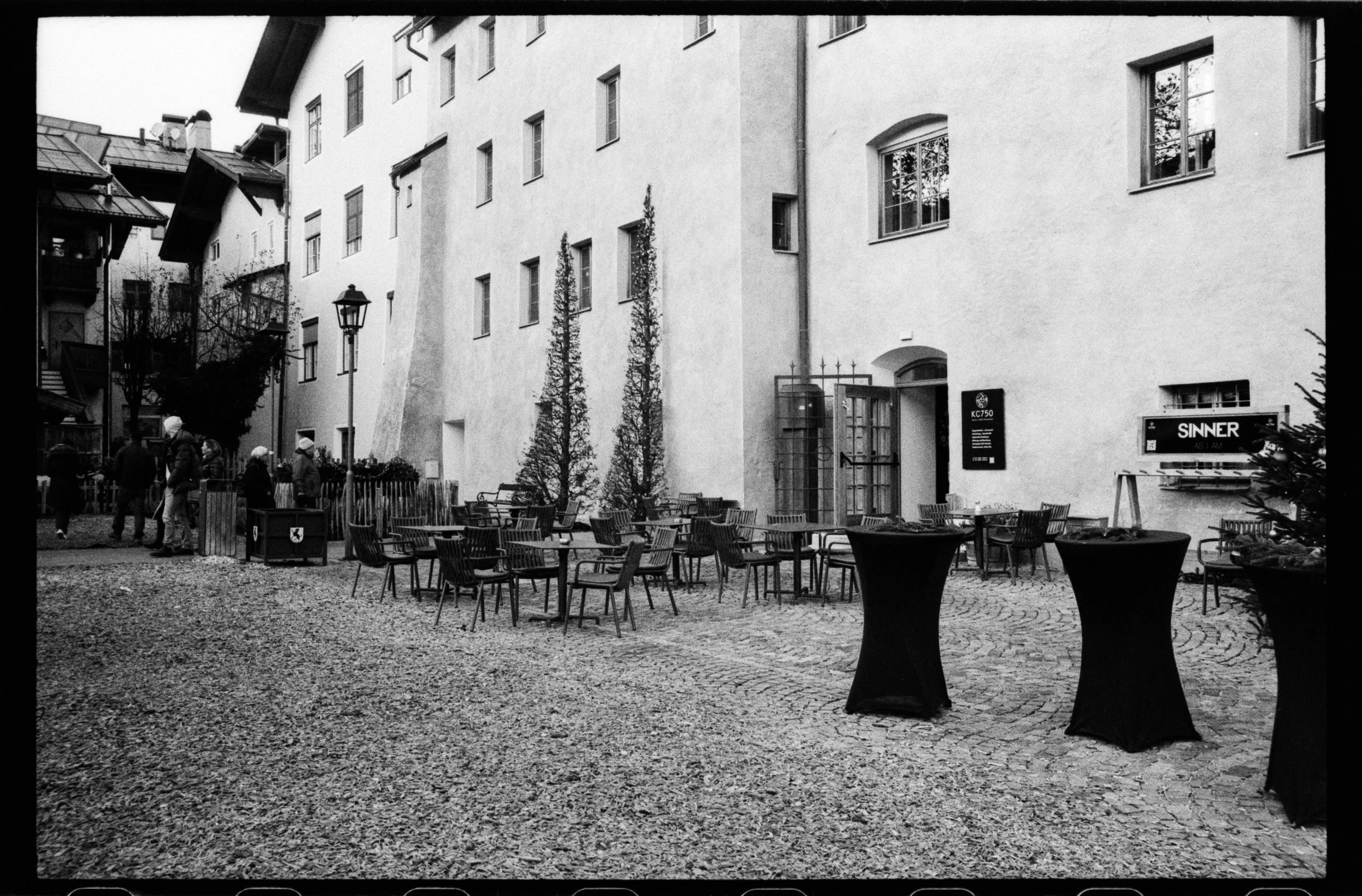
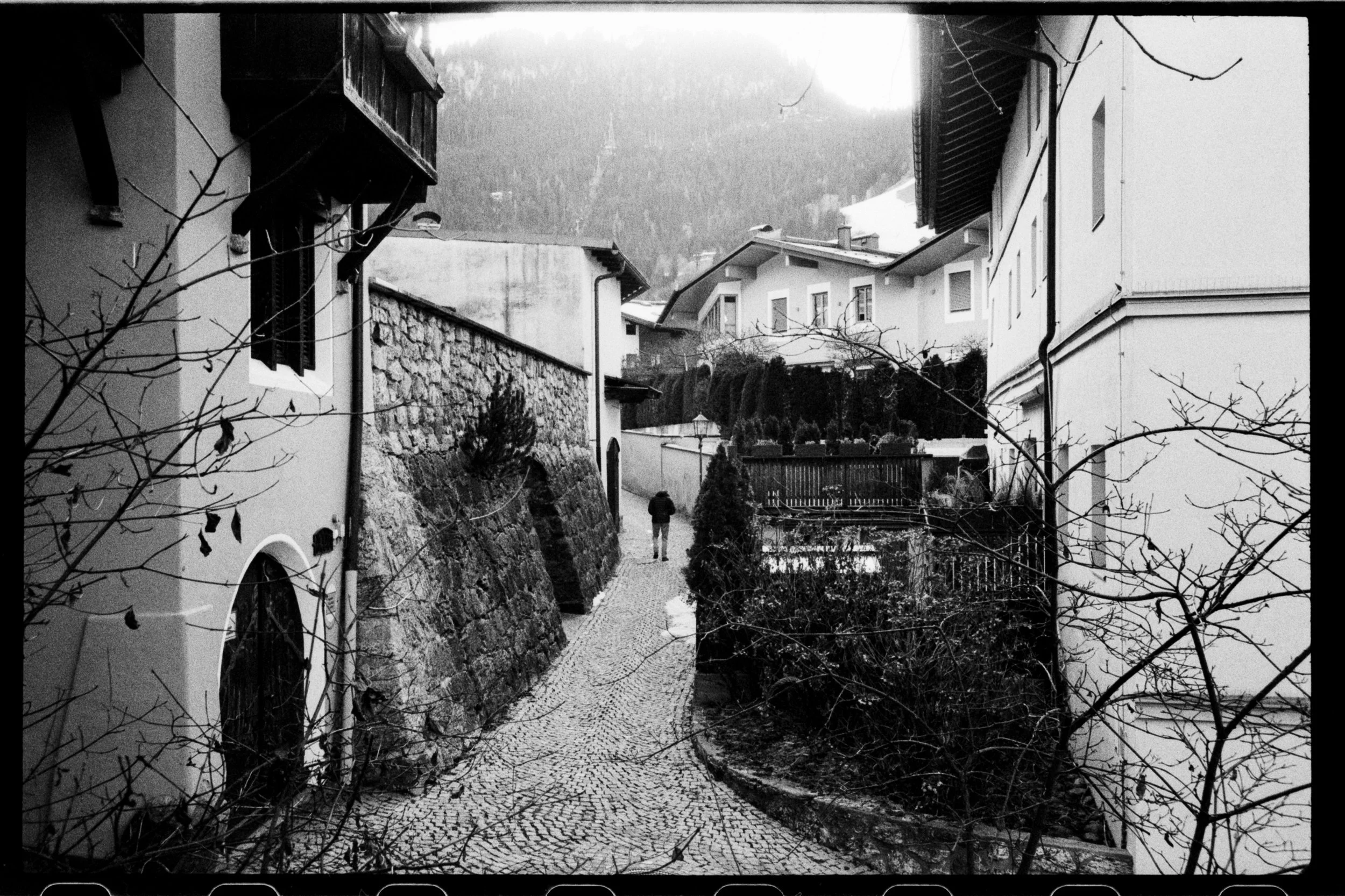
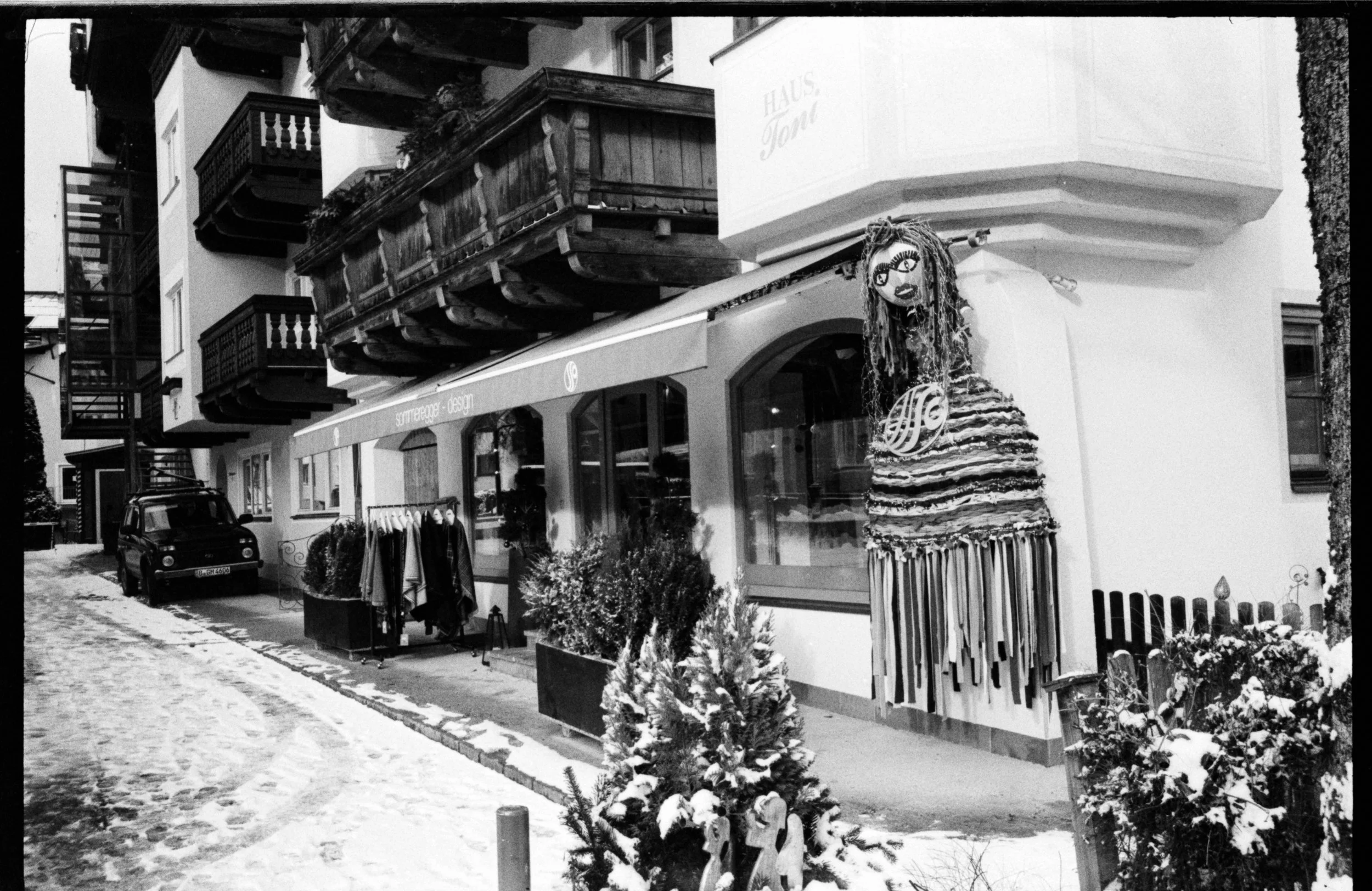
The Kitzbuhel of Leni Riefenstahl
Leica M6, 50mm Canon LTM F1.4
The road up to the Schwarzsee from Kitzbühel is a short one — twenty minutes on foot, less in a decent car — and at the end of it, on a low rise looking back at the water, stands the house where Leni Riefenstahl spent the end of the Second World War. Haus Seebichl. It is not a grand place. It is a solid Tyrolean property in a valley full of solid Tyrolean properties, and that, I think, is rather the point. In the first days of May 1945, with the Reich disintegrating and American armour pushing into the Tyrol, the most famous film director in Germany was sitting in a ski resort with her mother, her new husband’s absence, and several thousand feet of unfinished film. How on earth had she ended up there? The answer turns out to be a great deal less mysterious and a great deal more interesting than the conspiracy-minded version, and it tells us something useful about how the Nazi elite actually behaved when the roof came in.
Start with the obvious thing, which is that Riefenstahl had been coming to these mountains for the best part of twenty years. Her entire first career was built on them. The Bergfilme of the twenties and early thirties — Arnold Fanck’s Der heilige Berg, Die weiße Hölle vom Piz Palü, Der weiße Rausch — demanded a crew who could ski at genuine competition standard while lugging heavy hand-cranked cameras across glaciers, and that crew came almost entirely out of the Austrian and Bavarian alpine sporting world. Men like Guzzi Lantschner and Walter Riml were racers first and cameramen second. Hans Ertl was a serious mountaineer. Riefenstahl learned to ski properly to keep up with them, and she kept the network afterwards, pulling several of them into Olympia in 1936. It’s worth pausing on this, because it means Kitzbühel wasn’t a bolt-hole she picked off a map. It was the professional and social ground she’d been standing on since 1926.
Then there’s the war itself, and here the logistics matter more than the psychology. By 1943–44 Berlin was being systematically flattened, and the German film industry was doing exactly what every other industry was doing: dispersing southwards, away from the bomber streams, into the Alps. Negatives, cutting benches, cameras, personnel — all of it went. Riefenstahl’s Tiefland, a production already trailing the appalling business of extras taken from the Sinti and Roma camp at Maxglan, was still unfinished and went south with her. She married the Wehrmacht officer Peter Jacob in Kitzbühel in March 1944. Her mother came too. Strip out the celebrity and what you have is a middle-aged woman moving her family, her job and her filing cabinets out of a burning city to a place she knew well. Thousands of Germans did precisely the same thing that year. The difference is that most of them hadn’t made Triumph of the Will.
What she almost certainly did not anticipate was the sheer weight of Allied force that would arrive in her valley, and the reason for that has nothing to do with her at all. Allied intelligence had convinced itself — wrongly, as it turned out, and expensively — that the Nazi leadership intended to withdraw into an Alpine Redoubt, the Alpenfestung, and fight on from fortified mountain positions in exactly this stretch of Austria and southern Bavaria. Eisenhower took it seriously enough to shape strategy around it. In reality the Redoubt was very largely a fantasy, part wishful German propaganda and part Allied intelligence feeding on its own shadow, but the consequence was real enough: in early May 1945 American divisions came pouring into the Tyrol looking for a last-ditch fortress that did not exist, and found instead the assorted flotsam of the Third Reich sitting in requisitioned chalets. Riefenstahl was one of them.
She was taken into custody in the Kitzbühel area that month, and among those who came looking for her was Budd Schulberg — the American novelist, then working on the Allied effort to hunt down film footage for the coming trials at Nuremberg. Accounts of what passed between them vary in tone and detail, as accounts of that particular chaotic fortnight almost always do, and Riefenstahl’s own version shifted across fifty years of retelling until it was less a memory than a position. What isn’t in doubt is the outcome. The house was requisitioned. Material was seized. And the woman who had spent a decade exercising total control over how she and her regime were photographed suddenly had none whatsoever.
She never came back, in any meaningful sense. Denazification ground on into the early fifties, bouncing her between American and French jurisdictions before landing on Mitläufer — fellow-traveller — a classification that satisfied absolutely nobody. A great deal of the Tiefland footage disappeared into French hands and took years of wrangling to prise loose, some of it never recovered in usable condition. She rebuilt her life in Bavaria and spent the next half-century curating her own record with extraordinary discipline: the Nuba, the underwater films, the interviews, the lawsuits. And yet the Tyrol, which had made her and then finished her, barely features. That’s the genuine puzzle in all this. Not what she was hiding at Kitzbühel — there’s no evidence she was hiding anything — but why a woman so brilliantly attuned to the meaning of mountains had so little to say about the one valley where her war actually ended. My own view is straightforward enough. There was no version of that story that did her any good, so she simply declined to tell it