Leica Standard at The Guildhall, October 2026
The London Transport Museum Annual Dinner
A particular kind of optimism is required to photograph a London evening event with a Leica Standard, and I'm not sure I possess it in sufficient quantity. The Standard, for those who have never had the pleasure, is a camera from the early 1930s that Leica built for people who felt a rangefinder was a frivolous extra, like heated seats or a second kidney. You do not focus it so much as guess, estimating the distance to your subject with the confidence of a man reading a map upside down, then turning the lens to a number and hoping for the best. I loaded it with the fastest film I could find, slotted it into my pocket where it sat like a small, cold brick, and set off for the Dr Butler's Head on Mason's Avenue for pre-drinks. This is a pub that has been pouring beer in the City since the days when a doctor's main prescription was, apparently, more beer. It was full of transport enthusiasts, which is to say the friendliest and most precisely informed people in Britain. Within four minutes a gentleman had told me the exact gradient of the Metropolitan line north of Harrow, and I had taken a photograph of his left ear.
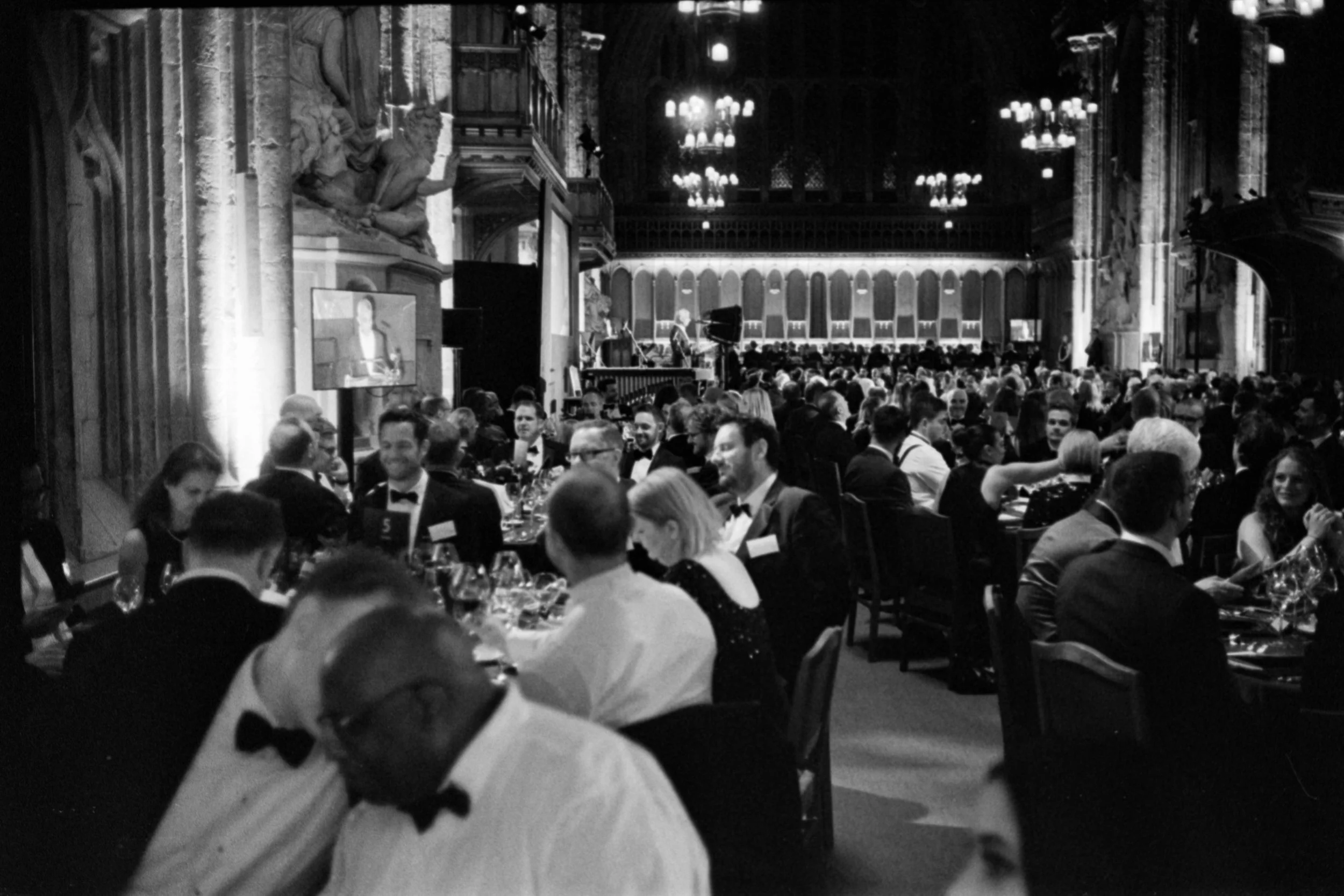
The Guildhall itself is the sort of building that makes you stand up straighter without being asked. It has been the seat of City government for roughly six hundred years. The Great Hall is vast and gothic, lined with banners and monuments to people who were clearly very important and are now chiefly famous for being carved in marble. It is also, for photographic purposes, quite dark. The Standard's slowest shutter speed is a twentieth of a second, a figure that assumes either a sunlit afternoon or a photographer with the nerves of a bomb disposal expert. I braced myself against pillars and held my breath until I went slightly purple. I paced out distances to the lectern in small, furtive steps, like a man measuring up a room for carpet he cannot afford, and earned several curious looks from the waiting staff. Everyone else was taking pictures on phones that could see in the dark, recognise faces, and very likely file their tax returns. I was winding on with my thumb like a Victorian.
Then came the speeches. Andy Lord, the Transport Commissioner, spoke with the calm of a man who has spent years keeping eight million people moving underground and who is no longer alarmed by anything, least of all a room of philanthropists with wine glasses. He was followed by Sadiq Khan, who did what all mayors do at these things: he charmed the room, praised the museum, and gently implied that everyone present could be a little more generous when the auction came round. I fired off the rest of the roll, guessing at four metres, then three and a half, then, in a moment of despair, "about there." Whether any of it is in focus I will not know until the negatives come back. That is, I've come to realise, the whole point of a camera like the Standard. It doesn't let you check, and it doesn't let you fuss. It makes you stand in a magnificent old hall full of good people raising money for old buses, and actually look at it.…..